This article is part of the AI-Assisted Software Engineering series. Use the series guide to follow the complete reading path.
We use many analogies to describe AI coding assistants. Some call them junior developers. Some call them interns. Some say they are freshers on steroids. Some describe them as AI pair programmers. Others call them autocomplete on steroids, or Stack Overflow that talks back.
Each analogy captures something useful.
A coding assistant can write code. It can answer technical questions. It can explain frameworks. It can generate tests, refactor methods, and sometimes produce surprisingly sophisticated solutions.
So it is understandable that developers try to compare it with something familiar. But analogies can also mislead us. When we choose the wrong analogy, we bring the wrong expectations.
And that is where many teams get frustrated.
The same coding assistant that generates useful code in one situation may make obvious mistakes in another. It may miss important requirements. It may invent APIs. It may ignore hidden business rules. It may confidently generate code that looks clean but is wrong for the system.
The problem is often not the tool. The problem is the mental model. We expect coding assistants to behave like people, but they do not work the way people work.
To understand why, consider what happens when a new engineer joins your team.
The Onboarding Difference
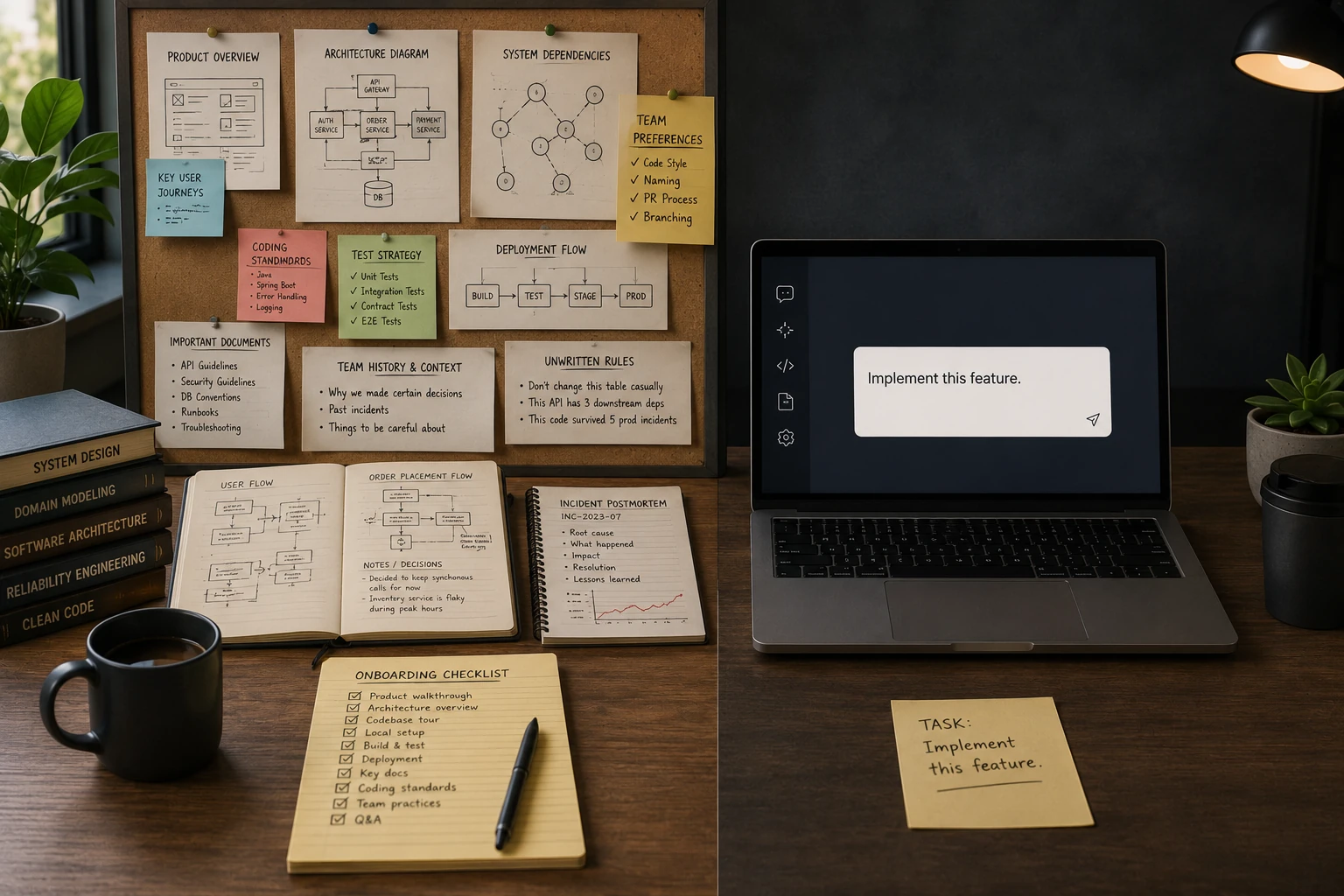
Think about what happens when a new engineer joins your team. You do not just give them the repository link and say, “Start building features.” At least, not on a healthy team.
You usually do a few things first. You explain what the product does. You walk them through the main user journeys. You show them how the codebase is structured. You explain the local setup, the build process, the test strategy, and the deployment flow.
You point them to important documents. You tell them which parts of the system are stable and which parts are messy. You explain naming conventions, coding standards, review expectations, and team preferences.
You also share the things that are not written anywhere. Why one service is designed in a strange way. Why a certain table should not be touched casually. Why one API looks simple but has three downstream dependencies. Why a piece of code that looks ugly has survived five production incidents.
That context matters.
Without it, even a smart engineer can make poor decisions.
Now compare that with how many teams “onboard” a coding assistant. They install the extension. They open the repository.
They type:
“Implement this feature.”
And then they are surprised when the assistant makes bad assumptions.
It does not know the product. It does not know the history. It does not know your team’s unwritten rules. It does not know which parts of the system are risky. It does not know what the last production issue taught you.
It only knows what you give it in the current context.
That is the first important difference.
A junior developer joins a team and gradually builds understanding. A coding assistant receives context and generates from it.
If the context is weak, the output will be weak.
Not because the tool is useless. Because we treated it like someone who had already been onboarded.

A healthy team does not onboard engineers with just a repository link.
The Biggest Mistake Developers Make About AI
When a new engineer joins your team, you expect certain things. You expect them to understand requirements. You expect them to ask questions when something is unclear. You expect them to remember previous discussions. You expect them to understand why a design decision was made.
And if they do not know something, you expect them to learn over time. Many developers unconsciously expect the same behavior from coding assistants.
That is the biggest mistake developers make.
Coding assistants are not junior developers.
They are something else entirely. And the sooner you understand that distinction, the more productive you become.
The Mental Model Problem
Whenever a new technology arrives, we try to understand it using familiar analogies. Early automobiles were called “horseless carriages.” Cloud computing was described as “someone else’s computer.” AI coding assistants are often described as “junior engineers.”
The analogy sounds reasonable.
“This is like having a junior developer on my team.”
But that mental model breaks down almost immediately. A junior developer and a coding assistant may sometimes produce similar outputs. They do not operate in the same way.
What Junior Developers Actually Do
A junior engineer possesses something extremely important:
Understanding.
Perhaps incomplete understanding. Perhaps shallow understanding. But understanding nonetheless.
When a junior developer joins a project, they gradually build a mental model of:
- The product
- The business domain
- The architecture
- The coding standards
- The team’s preferences
- Historical decisions
Over time, they accumulate context. When they make a mistake, they learn from it. When they encounter a new problem, they relate it to previous experiences.
Their knowledge evolves. Their understanding deepens. Their judgment improves.
That is what humans do.
What Coding Assistants Actually Do
Coding assistants operate very differently. At their core, they are prediction systems. Given a context window, they predict what content is most likely to come next.
That sounds simple. Almost disappointingly simple. Yet it is extraordinarily powerful.
Because they have been trained on enormous amounts of:
- Source code
- Documentation
- Technical discussions
- Design patterns
- Open-source projects
- Tutorials
- Books
As a result, they become incredibly good at recognizing patterns. Show them a REST controller, and they can generate a service layer. Show them a database schema, and they can generate repository classes. Show them a unit test pattern, and they can produce dozens more.
The key point is this:
They are generating based on patterns they have seen before. Not because they truly understand your system the way a human engineer does.
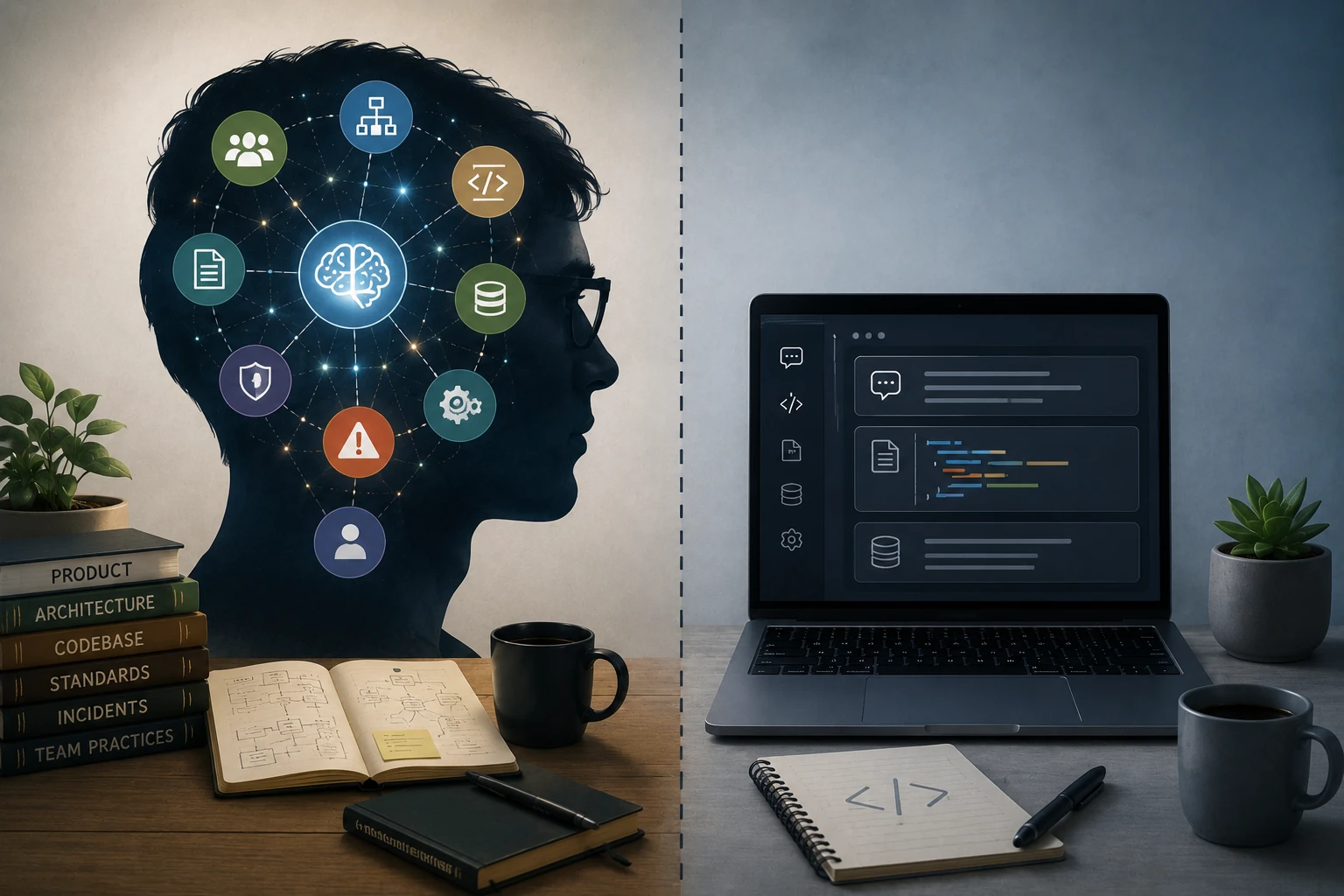
Humans build understanding over time. Coding assistants operate within the context they receive.
Pattern Prediction Is Not Understanding
This distinction is subtle but critical. Consider autocomplete in your IDE.
If you type:
List<Customer> customers =
Your IDE can often predict what comes next. That prediction does not imply understanding. It is simply pattern matching.
Coding assistants operate on the same fundamental principle. Of course, modern models are vastly more sophisticated than autocomplete. But the underlying mechanism remains pattern prediction.
This leads to an important observation:
Sometimes they appear to understand. Sometimes they genuinely feel intelligent. And often they produce results that are remarkably useful. Yet their failures reveal their true nature.
They can:
- Invent APIs
- Reference non-existent methods
- Misinterpret requirements
- Produce logically inconsistent solutions
- Miss hidden business constraints
Not because they are careless. But because they are predicting. Not reasoning about your system the way humans do.
Why Treating Them Like Employees Fails
Imagine assigning a task to a junior developer.
You might say:
“Please implement customer onboarding.”
The junior developer would likely respond with questions.
- Which customer type?
- What validations are required?
- What are the edge cases?
- How should failures be handled?
Now imagine giving the same vague instruction to a coding assistant. What often happens?
It starts generating. Immediately. Confidently. Sometimes incorrectly.
The model is trying to be helpful. Its job is to continue the pattern. Not necessarily to challenge assumptions.
This creates frustration.
Developers complain:
- “The AI misunderstood me.”
- “The AI made assumptions.”
- “The AI generated the wrong thing.”
In many cases the assistant did exactly what it was designed to do. The problem was the expectation.
You expected an employee. You got a prediction engine.

Humans clarify, challenge, and learn. Coding assistants generate from the available context.
The Calculator Analogy
A better analogy is not a junior developer. It is a calculator.
A calculator can perform arithmetic much faster than a human. But nobody expects a calculator to understand accounting. Nobody expects a calculator to understand business strategy. Nobody expects a calculator to decide which numbers matter.
Humans provide the problem. The calculator accelerates the execution. Coding assistants work similarly.
You provide:
- Intent
- Constraints
- Context
- Architecture
- Acceptance criteria
The assistant accelerates implementation. The quality of the result depends heavily on the quality of the inputs.
The Real Superpower
Once you stop treating coding assistants as employees, something interesting happens. You begin using them differently. Instead of delegation, you focus on augmentation.
You stop asking:
“Can the AI build this for me?”
And start asking:
“Which parts of this work can the AI accelerate?”
That shift changes everything.
Coding assistants excel at boilerplate generation: controllers, DTOs, configuration files, test scaffolding, and infrastructure code.
They excel at pattern replication. Once you show one example, they can often generate twenty more. This is incredibly useful in large codebases.
They help with knowledge retrieval. Need a reminder about Spring Security, Kubernetes, OAuth, or Kafka? They can often provide answers faster than searching documentation.
They are useful for first drafts: architecture proposals, design documents, migration plans, and technical specifications. Rarely perfect. Often useful.
They can also help with code review by identifying potential bugs, missing validations, security concerns, and refactoring opportunities.
Not as the final reviewer. As an additional reviewer.
What Experienced Engineers Discover
The most productive engineers do not use coding assistants as replacements. They use them as force multipliers.
They remain responsible for:
- Architecture
- Design decisions
- Business correctness
- Trade-offs
- Production readiness
The assistant helps with execution. Think of a skilled carpenter.
Power tools make the carpenter faster. They do not replace craftsmanship. An inexperienced carpenter with expensive tools still produces poor furniture. An experienced carpenter with good tools becomes exceptionally productive.
Coding assistants behave similarly. The engineer remains the craftsman. The assistant becomes the power tool.

The engineer remains responsible. The assistant amplifies execution.
Working With Coding Assistants Effectively
The most successful teams do not treat coding assistants as autonomous developers. They treat them as highly capable engineering tools.
That means:
- Give them context, not just tasks.
- Provide examples of existing patterns.
- Share constraints and requirements.
- Review outputs before accepting them.
- Use them to accelerate decisions, not replace judgment.
The goal is not to remove the engineer from the process. The goal is to make the engineer more productive. When used this way, coding assistants become one of the most powerful productivity tools software engineering has seen in decades.
A Better Mental Model
If I had to summarize coding assistants in one sentence:
Coding assistants are pattern engines that amplify engineering capability when guided by strong human judgment.
Not junior developers. Not replacements. Not autonomous engineers.
Powerful tools. Very powerful tools. But still tools.
Once you adopt that mental model, many frustrations disappear. You stop expecting understanding where there is prediction. You stop expecting ownership where there is generation.
And you start focusing on the real question:
How can I combine my experience, judgment, and domain knowledge with this extraordinary pattern-generation capability?
That is where the productivity gains truly begin. And that is where most developers are only starting to scratch the surface.
Final Thoughts
The lesson is not to lower your expectations of coding assistants.
The lesson is to change your expectations. Stop treating them like junior engineers. Start treating them like powerful engineering tools that require context, guidance, and review.
The teams that make this shift are often the teams seeing the biggest productivity gains from AI today.
This naturally leads to the next question: if coding assistants depend so heavily on context, what kind of context should we actually provide?
That is where AI-assisted software engineering becomes less about prompts and more about engineering discipline.